

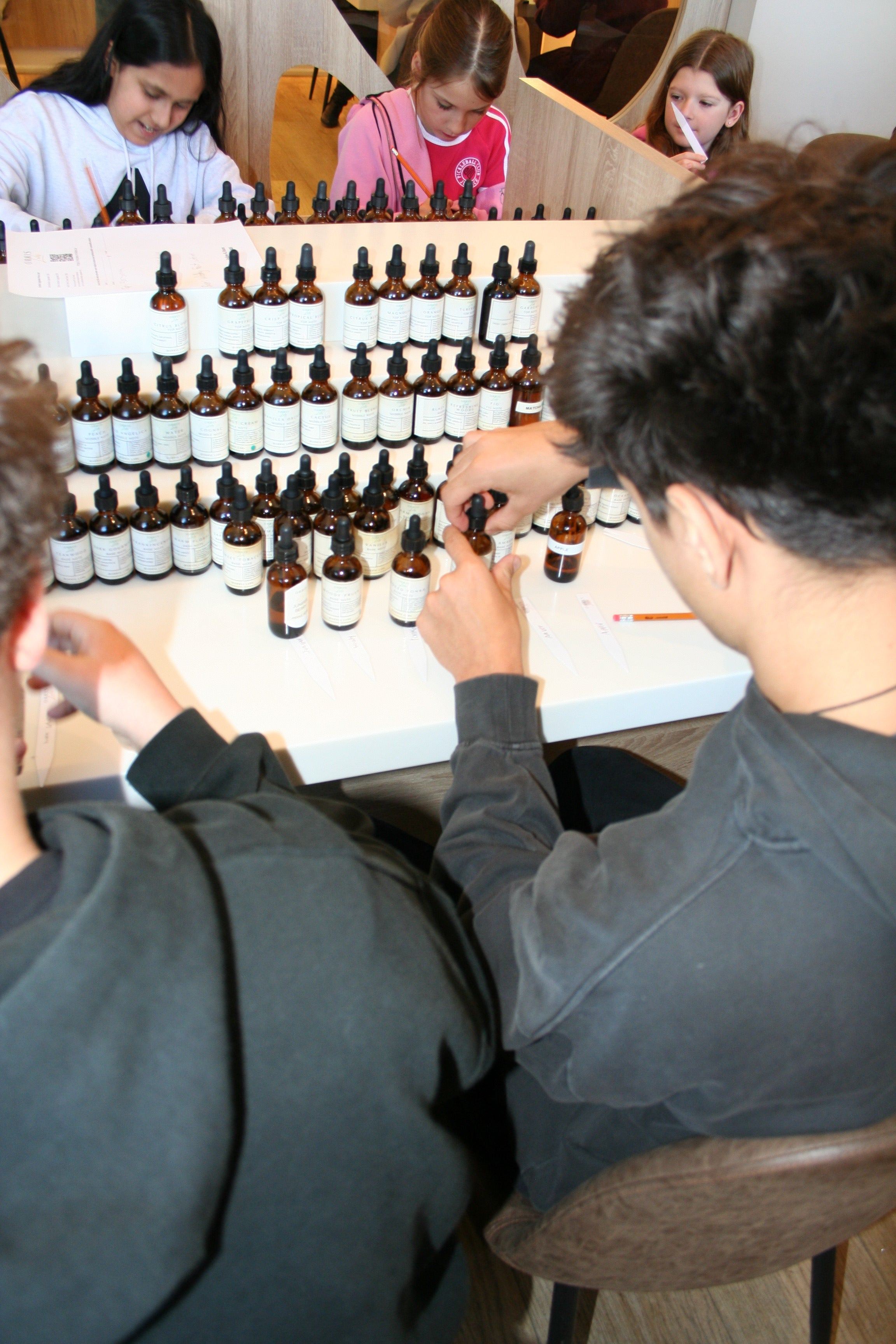
When most people think of STEM for kids, they imagine robots, coding apps, or building bridges out of popsicle sticks. But science isn’t limited to circuits and machines, it’s also hiding in the tiny molecules that make lavender soothing, citrus refreshing, and vanilla comforting. A fragrance workshop, at first whiff, may seem more like art than science. In truth, it’s a hands‑on gateway to chemistry, biology, math, and design, all wrapped in one joyful sensory experience.
Beyond the Robots: Reimagining STEM for Curious Kids
We know STEM education builds critical thinking, problem‑solving, and creativity. But not every child connects with the hard edges of robotics or coding. Some thinkers are dreamers and creators, drawn to colors, sensations, and stories. A fragrance workshop opens the STEM door in a new way, one that engages the senses, imagination, and curiosity together.
Hands‑on experiments teach kids to measure precisely, test and adjust mixtures, and analyze results, the same iterative process scientists use every day. When perfume‑making becomes a lab challenge, children not only mix scents but also explore ideas, form hypotheses (“What happens if I add more lemon?”), and test how aromas evolve over time.
How Perfume‑Making Teaches Science
A kids’ fragrance lab looks surprisingly similar to a chemistry workshop: beakers, droppers, and precise ratios. Young perfumers learn about evaporation, solubility, filtration, and even basic distillation concepts, real science in an accessible, playful form. They also tap into biology by exploring how the nose detects smells and how the brain stores scent memories.
Math sneaks in, too... measuring milliliters, balancing ratios like 3:2:1 for top, middle, and base notes, and tracking formulas for reproducibility. The result? A beautiful example of inquiry‑based learning where observation, data, and creativity blend seamlessly.
The Joy and Reward of Making Something That is Theirs
What makes this workshop irresistible is its personal outcome. Kids don’t just learn abstract ideas; they leave with something tangible and entirely their own. A scent they designed and bottled. The experience feels playful yet grown‑up, merging science with imagination and self‑expression. Breathing in lavender or citrus while mixing and pouring keeps them focused in a way that coding sometimes can’t.
And that engagement matters. Research shows out‑of‑school STEM experiences, like camps and workshops, dramatically improve kids’ interest in science and math while boosting their confidence. In a relaxed, joy‑filled environment, learners are free to experiment, make mistakes, and try again, a critical habit for success in any STEM field.
A Fresh, Inclusive Take on STEAM
Fragrance workshops are still a hidden gem in the world of STEM education. While some museums or kits touch on scent chemistry, few programs treat it as a recurring, structured exploration. Yet it naturally fits today’s STEAM focus, blending science with art, design, and storytelling.
Best of all, fragrance labs attract a broader range of kids. Children who might be less drawn to robotics or engineering often leap at the chance to “be a perfumer.” It connects to interests in fashion, nature, or even fantasy characters, making science feel more personal and inviting.
The Future Smells Bright
Perfume‑making helps kids see that science isn’t just something you learn — it’s something you can feel, smell, and create. For a generation growing up in a world of digital screens, reconnecting STEM with the senses might just be the key to deeper curiosity and discovery.
So perhaps the next great innovation in science camps won’t come from the hum of a robot but from the swirl of a scent that began in a child’s curious experiment.
Want to book in your next kids workshop at Orris?
Email us at info@orrislabs.ca for special rates and group bookings.


